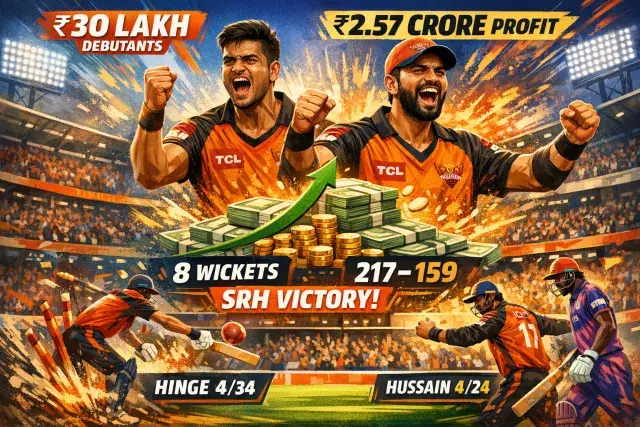

For the cost of a mid-range family sedan, Sunrisers Hyderabad extracted the kind of return that franchises typically associate with their most expensive auction acquisitions. Praful Hinge and Sakib Hussain, each purchased for ₹30 lakh, combined for eight wickets in a single outing and generated a calculated profit of ₹2.57 crore against their effective match-day investment of ₹6 lakh. The result was a 57-run victory over Rajasthan Royals, who entered on a four-win streak and fell for 159 while chasing 217.
The Collapse That Arrived Before the Chase Could Take Shape
Rajasthan had genuine reason for confidence at the halfway point. They carried batting depth, recent momentum, and had already demonstrated this season that large totals were manageable. SRH's 216/6 was demanding, but not beyond the range of a side that had been building form through consecutive victories. What followed was not a gradual erosion. It was structural failure within the first three overs.
Praful Hinge, taking the new ball on debut, dismissed Vaibhav Sooryavanshi, Dhruv Jurel, and Lhuan-dre Pretorius in his opening over. He later removed Riyan Parag to finish with 4/34. That sequence did not merely reduce Rajasthan's run-rate calculation. It eliminated the batting foundation before it could be established. The middle order inherited a position defined entirely by survival, not pursuit.
Sakib Hussain reinforced the damage from the other end. He dismissed Yashasvi Jaiswal early, then returned to remove Donovan Ferreira, Jofra Archer, and Ravi Bishnoi, finishing with 4/24. His contribution served a different function from Hinge's — not the initial rupture, but the sustained pressure that prevented any form of reconstruction. Together, they divided the innings across phases and left no window for a recovery effort.
Why the Same Auction Price Produced Different Returns
Both bowlers cost ₹30 lakh at auction. Both played their fifth outing for the franchise, setting the effective per-appearance cost at ₹3 lakh each. Both took four wickets. Yet the impact model assigned Praful Hinge a match worth of ₹1.49 crore against Sakib Hussain's ₹1.14 crore. The difference is not arbitrary. It reflects the timing and structural consequence of each bowler's contribution.
Wickets at the top of an innings, when the chasing side is still fully intact and strategically organised, carry greater weight than wickets taken once an innings is already compromised. Hinge's burst arrived precisely when Rajasthan had maximum resources and full intent to pursue. Removing three of those resources in a single over and then adding the captain did not merely make the task harder — it changed the nature of the task entirely. Sakib's wickets confirmed and extended the collapse, but the original structural damage had already been inflicted.
The impact model accounts for this by weighting wicket quality according to phase, pressure context, dot-ball contribution, and economy relative to the match situation. The resulting monetary figure is then measured against the effective per-appearance investment to produce a profit or loss calculation. On this occasion, Hinge's return was ₹1.46 crore in profit. Sakib's was ₹1.11 crore. Combined, SRH recovered ₹2.63 crore in match worth from ₹6 lakh of investment.
What Roster Efficiency Actually Looks Like at Scale
IPL auctions routinely generate multi-crore headlines, and the dominant logic of franchise building has long centred on securing the highest-value names before rival bidders do. That logic is not wrong — proven performers command premium prices for legitimate reasons. But it creates a structural blind spot around the value that can be extracted from the auction's lower tiers, where prices are modest and expectations are often correspondingly low.
The ₹2.57 crore profit figure sits in instructive context. It exceeds the combined auction value of both bowlers by a factor of more than four. It is large enough, in consumer terms, to purchase approximately 573 PS5 Slim consoles, 158 Royal Enfield Hunter 350 motorcycles, or 215 Samsung Galaxy S25 Ultra handsets. Those comparisons are illustrative rather than meaningful in themselves, but they communicate the scale of the disparity between cost and return in a register that goes beyond cricket arithmetic.
For franchise management, the lesson is less about this specific pair and more about the methodology that identified them. When a ₹30 lakh acquisition produces match-worth returns that would justify a price fifteen times higher, the question worth asking is not whether the bowlers overperformed. It is whether the evaluation framework that priced them originally was working with incomplete information. Two-way value creation — finding underpriced talent and then deploying it correctly — is harder to replicate than a single auction result suggests, but this outing makes the strongest possible case for trying.
The Broader Implication for How Value Gets Distributed
Franchise sport operates on resource constraints. Every acquisition comes at the cost of another, and budget allocation decisions made months before an event plays out carry consequences that cannot be undone mid-season. That is what makes efficiency at the low end of the price spectrum so meaningful. A ₹30 lakh bowler who produces ₹1.49 crore in match worth does not just win one outing — he frees up capital that can be directed elsewhere without sacrificing performance.
SRH's batting provided the base here. Their 216/6 was a platform built by other hands. But the margin of victory — 57 runs, a comprehensive result against a side in genuine form — was created by the bowling combination, and specifically by the two cheapest contributors in the lineup. The arithmetic of this particular evening is simple: six lakh rupees in, two crore fifty-seven lakh rupees out. What it represents is less simple, and considerably more significant.