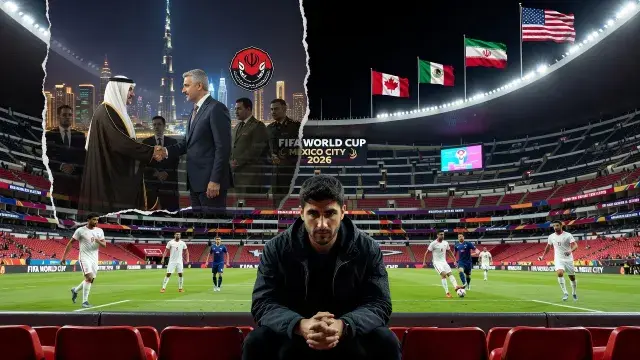
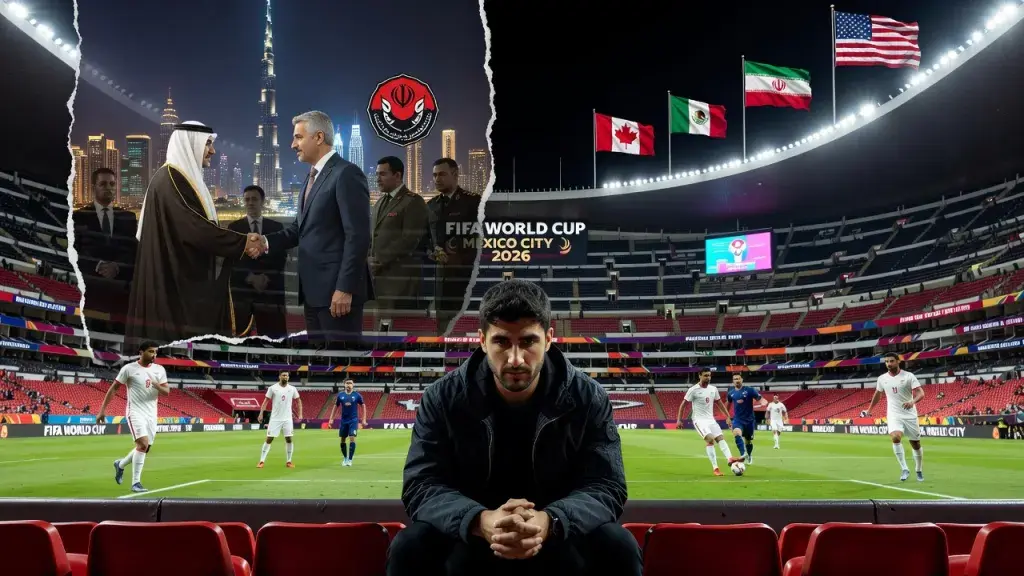
Iran are at the 2026 World Cup in the United States, Canada and Mexico. That, given the geopolitical turbulence that surrounded their participation since Operation Epic Fury began at the end of February, is itself a remarkable fact. But the country's most gifted footballer, Sardar Azmoun, made the journey only as a spectator - not because of injury, not because of a visa refusal, but because of a photograph and the politics that a photograph can carry in a country at war.
FIFA president Gianni Infantino, stroking the microphone at a rare media appearance on the eve of the tournament's opening game in Mexico City, was eager to take credit for Iran's presence. "When people were saying it would be impossible for Iran to come to the World Cup, I told them, and I promised them, that they would come," he said. He had even offered to drive a bus to Tehran himself, a pledge that sat oddly alongside the reality that U.S. President Donald Trump - the inaugural recipient of FIFA's newly minted Peace Prize - was simultaneously warning that the United States was prepared to "negotiate with bombs." The cease-fire between Washington and Tehran arrived on June 14, one day before Iran's opening group game against New Zealand. Iran flew to Tijuana from their pre-tournament base in Antalya, Turkey. Azmoun was not on the plane. In a tournament cycle that has produced extraordinary storylines across every discipline - much like how surfing live betting has drawn new audiences to niche action sports - it is the absences and the silences that often carry the most weight.
The explanation for Azmoun's exclusion, as reported by local Iranian media and cited by Reuters, traces back to January, when the 31-year-old striker posted a photograph of himself shaking hands with Sheikh Mohammed bin Rashid Al Maktoum, the ruler of Dubai, where Azmoun plays club football for Shabab Al Ahli. The Iranian Revolutionary Guard Corps responded on Telegram, labelling the gesture "co-operation with Iran's enemies" and accusing Azmoun of staying silent while what they described as the "American and Zionist regime" bombed Iran. The Wall Street Journal had reported in May that the UAE had covertly carried out strikes on Iranian territory, while the Emirati government documented a campaign of Iranian drone and missile attacks that caused deaths and injuries on UAE soil. Azmoun, living and working in Dubai, was caught in the middle of a conflict that had nothing to do with football and everything to do with where he chose to earn his living.
A Career Defined by Courage, On and Off the Pitch
What makes Azmoun's exclusion particularly difficult to absorb is the record of the man being left out. Third on Iran's all-time scoring list behind the legendary Ali Daei and the currently active Mehdi Taremi, he accumulated 57 goals across 91 international appearances. At Zenit Saint Petersburg, he won four Russian Premier League titles and was named the league's player of the year in 2021. Later came stints at Bayer Leverkusen and Roma. He was not the Iranian Messi - that label, applied online, was always hyperbole - but he was unambiguously the finest player his country produced in a generation.
This would likely have been his third and final World Cup. At 31, in an era of extended careers when Lionel Messi and Cristiano Ronaldo are both appearing at a record sixth tournament, Azmoun might have expected similar longevity. Instead, coach Amir Ghalenoei named Dennis Eckert - now carrying the Iranian passport name Dennis Dargahi - as a replacement of sorts. Born in Bonn to a father of Iranian descent, Dargahi is uncapped at senior level, played his youth football for Germany, and managed five goals in 35 Belgian league appearances for Standard Liege last season. He is 29 years old. He is not the next Azmoun; he is barely a stand-in.
Ghalenoei, when asked about the absence, reached for a curious comparison. "Sardar is an excellent player, he has done a lot for us, he is not with us, we wish he was, but this is football," he said. "I will give you an example: Neymar - it's possible he won't play in some games." The Neymar analogy was inexact at best. Neymar's absences have been shaped by injury and form. Azmoun's, by all available evidence, has been shaped by politics.
The Weight of Speaking Out
Azmoun's willingness to court official displeasure is not new. In 2022, after Mahsa Amini died in police custody and the Woman, Life, Freedom protests spread across Iran and around the world, he did not stay quiet. "At worst, I'll be dismissed from the national team," he wrote. "No problem. I'd sacrifice that for one hair on the heads of Iranian women. This story will not be deleted. They can do whatever they want. Shame on you for killing so easily; long live Iranian women." He kept playing for Iran after that - his last appearance came in March 2025, his final international goal coming against the UAE - but the accumulation of perceived slights, real and imagined, appears to have reached a tipping point.
"I have always played for my national team with pride," he wrote on Instagram after being omitted from Ghalenoei's preliminary squad. "I love football, and I love the good and deserving people of my country, Iran." He told Varzesh3 that his team-mates - Taremi, Shahriyar Moghanloo, Ali Alipour - had the quality to fill the gap. "Go out there and smash it," he told them. It read like the grace note of someone who knew the door had closed, and was choosing dignity over bitterness.
Iran at the World Cup, Azmoun Only in Spirit
Infantino declared, with characteristic self-satisfaction, that he had kept his promise to bring Iran to the World Cup. He was not wrong, technically. They are here. But the most complete version of Team Melli - with their third-highest scorer in tournament condition, in his prime, ready to face New Zealand, Belgium and Egypt - is not. The bus doors closed without him. The flight left from Antalya. And the question of whether football's governing structures, or the political forces that now shape them so visibly, bear any responsibility for that absence will linger long after the group stage is done.
To borrow Infantino's own frame: we do not live on the Moon. We live on planet Earth, where a footballer can be excluded from his country's World Cup squad not for what he did on a pitch, but for who he was photographed standing next to off it.